
What does SqlDBM give AI/ML leaders and CDOs? A cloud-native, governed data modeling platform that over 400,000 users worldwide already rely on to keep conceptual, logical, physical, and semantic layers aligned in one workspace. For AI/ML teams that live or die on trustworthy, well-structured data, that shared context layer is the difference between models you can query with confidence and answers you have to second-guess.
This is not theory. John Holland Group, one of Australia’s largest infrastructure firms with more than 70 years of data, completed its Databricks cloud migration in nine months with SqlDBM as the authoritative source for its gold-layer models, governed through a twice-weekly Data Modeling Forum. That is the kind of agility a CDO can defend to the board.
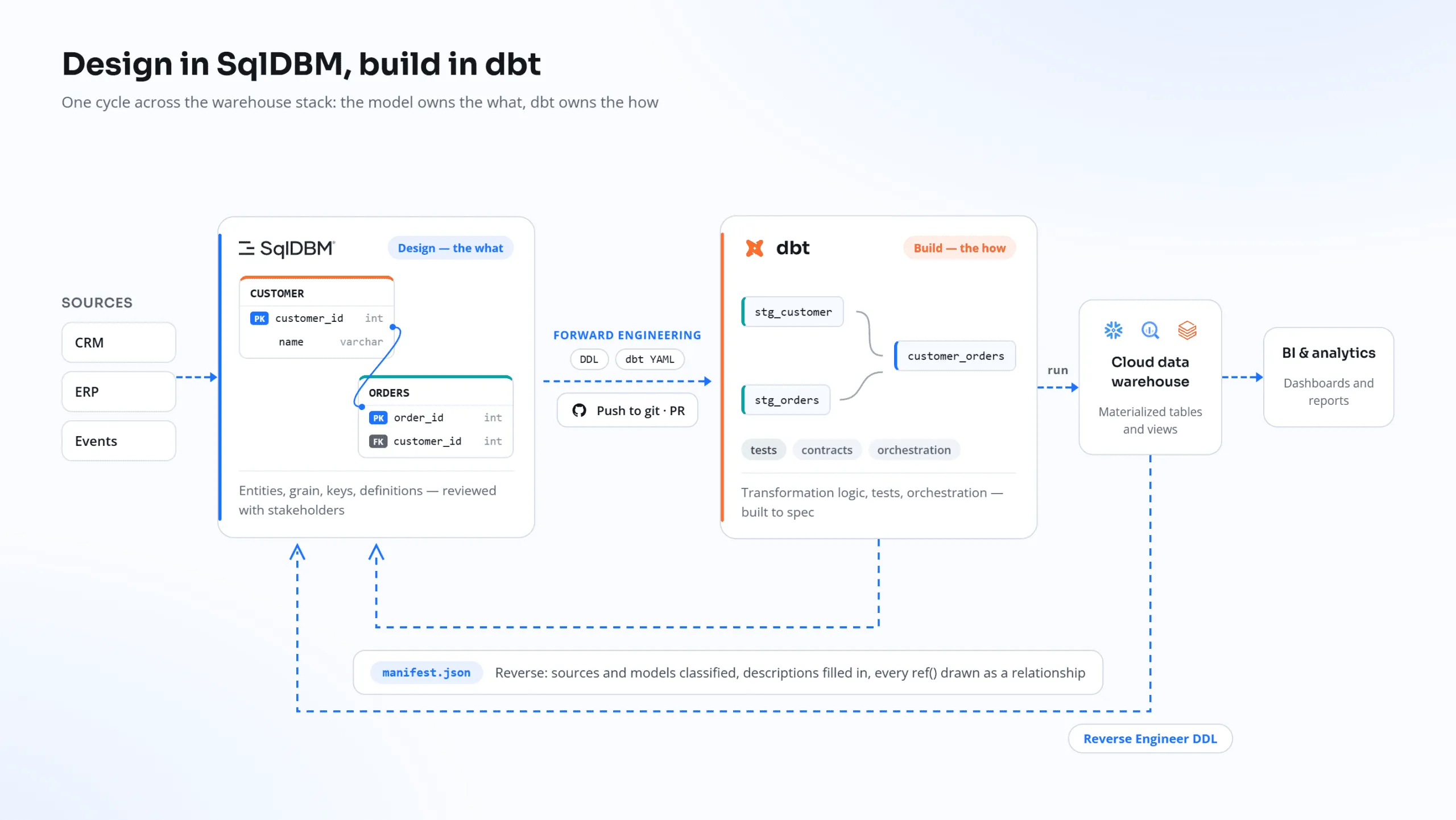
Scale is proven too. Mercadona, Spain’s largest supermarket chain, governs an Enterprise Data Model of nearly 5,000 tables in SqlDBM as the backbone of its Dato Unico single-source-of-truth strategy, and uses the SqlDBM API to auto-generate dbt models deployed to BigQuery and to encode metadata for future AI agents.
As AI and ML continue to evolve, the demand for high-quality, well-structured, and reliable data models will only increase, and the teams that get there fastest win. Midhun Paul at PwC reports SqlDBM cuts modeling time by twenty-five percent by removing much of the manual, repetitive labor, freeing architects to focus on the data itself. Organizations that invest in efficient data modeling today will have a distinct advantage in the coming years. By embracing SqlDBM, companies get a unified, governed approach to data management with real-time multi-user collaboration. Les Mills runs SqlDBM as its all-in-one tool for development, discovery, governance, and CI/CD across more than 1,000 Snowflake tables, chosen after erwin was rejected over usability and maintenance trade-offs. The ability to swiftly adapt to industry trends and technological advancements will be a defining factor for businesses aiming to stay ahead of the competition. In this fast-paced digital age, data is the foundation of success, and SqlDBM is built to help organizations harness it. That work has been recognized outside the house too: SqlDBM won Database Modeling Solution of the Year at the Data Breakthrough Awards two years running, in the 2023 and 2024 programs, judged by an independent panel of data science and technology experts.