


 Microsoft Fabric
Over the past decade, enterprise data infrastructure has changed dramatically.
Storage is elastic.
Compute scales automatically.
Cloud data warehouses handle workloads that once required months of tuning.
For most organizations, those problems are largely solved.
But another challenge has quietly become the limiting factor.
It’s not storage.
It’s not compute.
It’s shared understanding of what the data actually means.
Across large organizations, data now flows through dozens of systems: operational platforms, warehouses, lakehouses, pipelines, dashboards, and increasingly AI systems.
The challenge is no longer collecting data.
The challenge is ensuring that people, systems, and increasingly AI models interpret it the same way.
When that interpretation breaks down, the symptoms are familiar:
-
Dashboards that show different answers for the same metric
-
Data teams rewriting business logic across multiple pipelines
-
AI outputs that sound confident but feel incorrect
-
Business users slowly losing trust in analytics
When that happens, the issue is rarely the platform.
It’s almost always the data model.
And in 2026, AI is making that problem much harder to ignore.
What Changed: AI Is Now a Primary Consumer of Data
For years, enterprise data infrastructure was designed primarily for analytics.
Data pipelines ingested operational data.
Transformations shaped it for reporting.
Dashboards visualized the results.
Humans were the primary consumer of the system.
Humans are forgiving.
If a dashboard looks strange, someone investigates. Analysts apply judgment. Data teams correct issues over time.
However, AI systems operate differently.
AI models depend on structured, well-defined context. They cannot infer business meaning the way a human analyst can.
If the underlying data structure is inconsistent or poorly defined, the model still produces an answer, but it may be incorrect.
That risk is becoming more visible as enterprises deploy AI across analytics workflows.
Modern data platforms increasingly rely on semantic models that define business entities such as customers, orders, and revenue metrics so that both humans and AI systems can interpret data consistently.
These semantic layers allow platforms and AI agents to query structured data using shared business definitions rather than raw tables.
But there is a critical detail.
A semantic layer does not create structure out of nothing.
It depends on well-designed data models underneath it.
Without that foundation, the semantic layer simply reflects the same inconsistencies already present in the data platform.
The Enterprise Data Environment Is Becoming More Complex
Another reason data modeling matters more today is the growing complexity of modern data architecture.
Large organizations rarely operate on a single platform anymore.
A typical environment may include:
-
Snowflake or BigQuery for cloud data warehousing
-
Databricks or Spark for machine learning pipelines
-
dbt for transformation workflows
-
BI tools such as Tableau or Power BI
-
Operational systems feeding the warehouse
Each layer introduces its own metadata, transformations, and definitions.
As a result, organizations often maintain multiple versions of the same logic across systems.
Revenue may be calculated in a dbt model, with a different calculation appearing in a dashboard, and a third version exists inside a machine learning pipeline.
The result is fragmentation.
Industry analysts increasingly note that modern data stacks can include dozens of tools, and the integration burden alone consumes a large portion of data engineering time.
When business logic is distributed across pipelines and platforms, maintaining consistency becomes extremely difficult.
A strong data model acts as the structural backbone of the environment.
It defines the entities, relationships, and rules that all downstream systems rely on.
Without that backbone, the data platform becomes a collection of pipelines rather than a coherent architecture.
What Data Modeling Is Really Doing
At its core, data modeling isn’t about tables or columns.
It’s about making meaning explicit.
Every organization has assumptions embedded in its data:
-
What qualifies as a customer
-
When revenue is recognized
-
What counts as an event versus a transaction
-
Which relationships actually matter

When these assumptions are not formally encoded, teams recreate them independently.
Over time, those interpretations diverge.
Good data models capture meaning in a structured form — one that humans can discuss and systems can enforce.
That is why data modeling is increasingly best understood as metadata infrastructure.
It is where intent, structure, and semantics come together.
The Three Layers of Data Modeling
Enterprise data models typically operate across three layers: conceptual, logical, and physical.
Each layer solves a different problem.
Conceptual models align people
Conceptual models define the core business entities within an organization: customers, orders, products, accounts. They provide a shared language for discussing how the business operates. This is where misunderstandings surface early, while they are still inexpensive to fix.
Logical models create discipline
Logical models translate business concepts into structured relationships and rules.

They define how entities relate to one another, how metrics are calculated, and how data should behave across systems. This is where meaning becomes enforceable.
Physical models make systems run
Physical schemas implement those structures inside databases and data warehouses. They optimize for performance, scalability, and platform constraints. When organizations collapse everything into physical schemas, they may move quickly at first, but they lose the ability to explain why the data is structured the way it is.
That loss compounds over time.
How AI Systems Depend on Data Architecture
Most AI systems do not interact directly with raw operational data.
Instead, they rely on a structured architecture that organizes and defines information before it reaches machine learning models.
In a modern data environment, data typically flows through several layers.
When these layers are aligned, AI can operate effectively because the data reflects a shared understanding of the business.
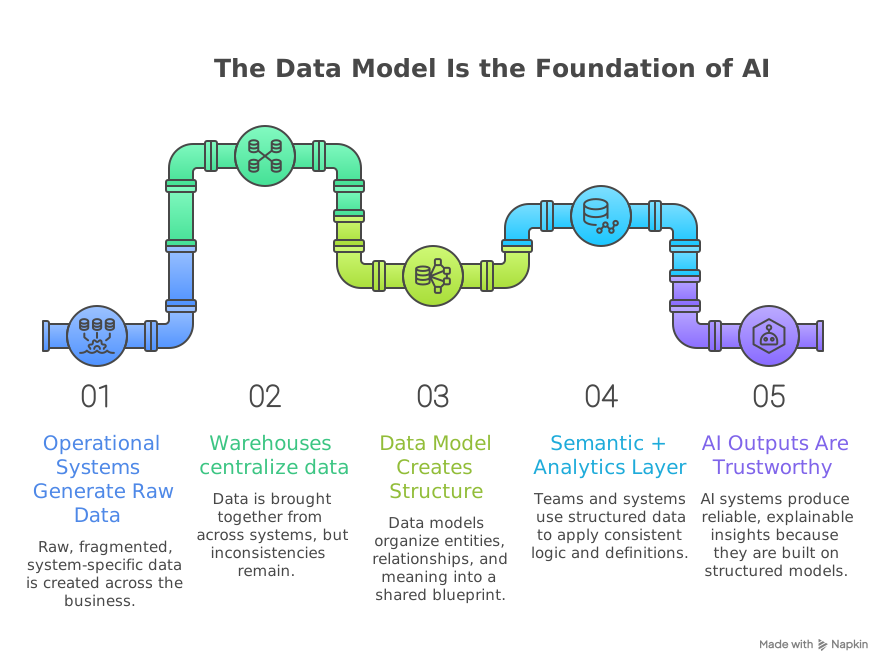
But when architecture is inconsistent, problems compound quickly.
Different teams may define the same concept in different ways. Relationships between entities may be ambiguous and business logic may be duplicated across dashboards, pipelines, and analytics tools.
In those situations, AI models learn patterns from the data without understanding the intent behind those patterns.
The models may still produce statistically strong outputs, but the results may conflict with how the business actually operates.
This is why strong data architecture matters before AI initiatives scale.
Conceptual and logical data models provide the semantic backbone that connects business concepts to physical data structures.
When organizations invest in modeling early, AI systems inherit a stable foundation.
When they do not, AI tends to expose the gaps that already existed in the data.
AI Exposes the Cost of Weak Data Models
AI systems amplify structural problems in data.
When humans analyze data, they apply context and experience. They recognize when a metric looks wrong.
AI systems rely entirely on the structure and semantics of the data they receive.
If those structures are inconsistent, the model has no way to detect it.
In practice, this creates several common problems:

These problems are not new.
But AI makes them visible much faster.
In a dashboard environment, inconsistencies might surface weeks later during analysis.
In an AI environment, they appear immediately as incorrect responses, flawed recommendations, or unreliable automation.
AI accelerates both insight, and error.
Why Enterprise Teams Need a Modeling Workflow
Most organizations understand the importance of modeling.
The challenge is operationalizing it.
In many enterprises, data models exist in one of three forms:
-
Static diagrams created early in a project
-
Implicit structures embedded in SQL transformations
-
Documentation that no longer matches production
None of these approaches work well for modern data environments.
Data models must evolve continuously as systems evolve.
That requires a workflow that connects modeling to the rest of the data stack.
Enterprise data teams increasingly look for tools that allow them to:
-
Design and maintain models collaboratively
-
Align models with transformation frameworks such as dbt
-
Document business semantics directly within the architecture
-
Track changes as systems evolve
-
Integrate modeling with modern cloud data platforms
This is where modeling platforms such as SqlDBM become valuable.
Turning Data Models Into Living Infrastructure
Traditional modeling tools were built for database architects working in isolation.
Modern data teams operate differently.
They collaborate across engineering, analytics, and business teams, they iterate quickly, and they manage cloud platforms that evolve constantly.
SqlDBM brings data modeling directly into that workflow.
Teams can:
-
Design and visualize data architecture collaboratively
-
Maintain models alongside transformation frameworks
-
Document entities and relationships within the platform
-
Keep architecture aligned with production systems
-
Support governance and shared understanding across teams
Instead of treating modeling as static documentation, the model becomes a living representation of the data platform.
This becomes especially important as organizations prepare their infrastructure for AI-driven analytics. AI systems depend on structured context. That context begins with a well-designed data model.
The Foundation Still Matters
Cloud platforms transformed how data is stored and processed. AI is transforming how data is used, but one principle has remained constant:
Data systems are only as reliable as the structure beneath them.
Data modeling provides that structure.
It defines the entities, relationships, and semantics that allow both humans and machines to interpret data consistently.
Organizations that treat modeling as a living discipline build analytics and AI they can trust.
Those that do not often find themselves reconciling numbers, explaining inconsistent outputs, and slowly losing confidence in their data.
The difference is rarely the platform.
It is the foundation.
To talk to our team about how SqlDBM can help your data team become AI-ready, request a demo here.